MoE-Bind: Guiding De Novo Protein Binder Generation with Sparse Experts
1 Computational Systems Biology Laboratory, Department of Bioinformatics, University of North Bengal, India
bioRxiv 2026.06.13.732043 · Posted June 13, 2026 · CC-BY 4.0
Overview video
Trouble playing? Watch on YouTube.
Abstract
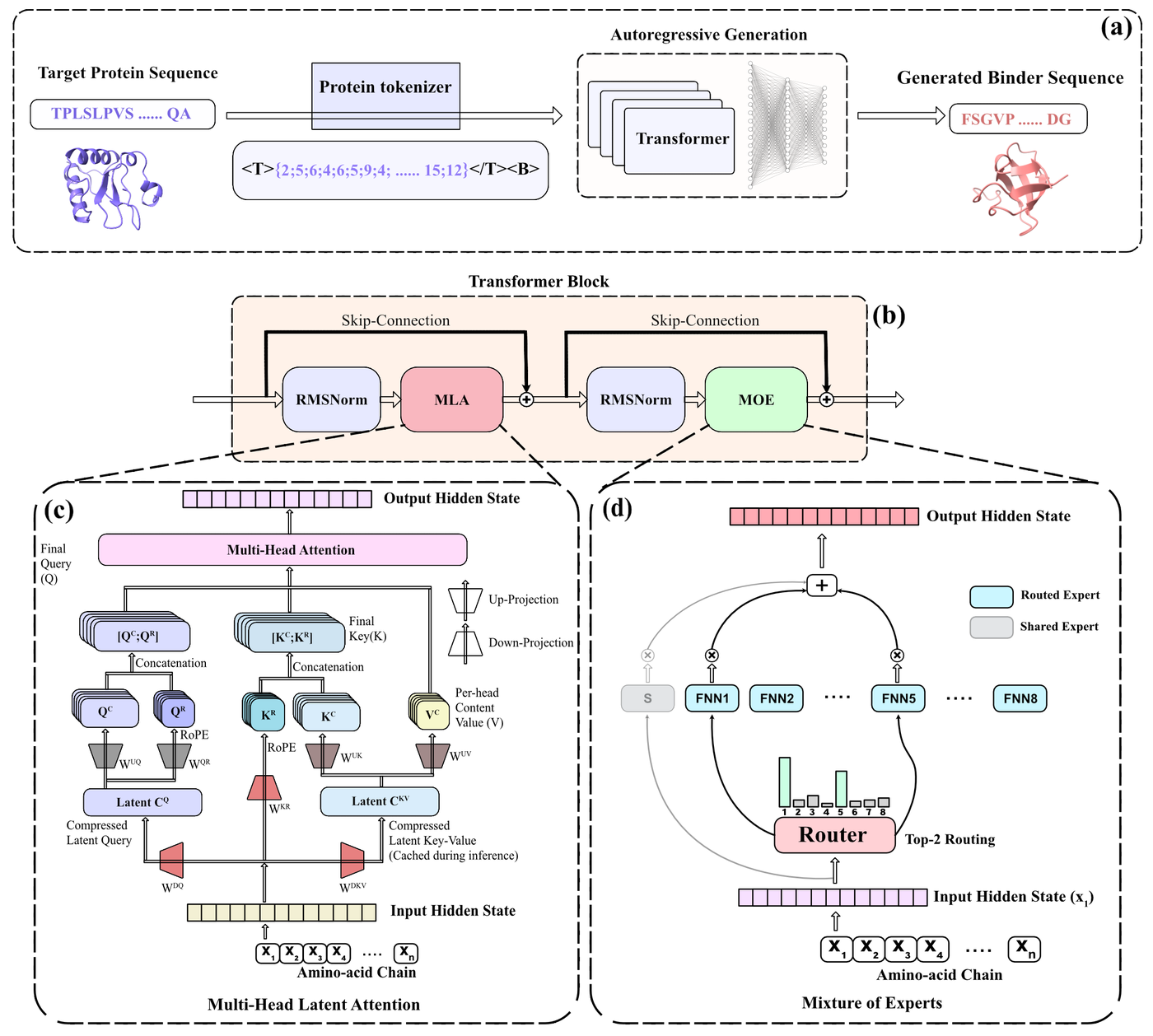
De novo protein binder design has been dominated by structure-based pipelines that require known three-dimensional target conformations and consume substantial compute per design, limiting throughput and accessibility. Sequence-only generative models promise a faster, lighter alternative, yet existing systems remain uniformly dense and frequently reintroduce structural computation at inference. Meanwhile, the language modelling community has transitioned from dense designs to sparse Mixture-of-Experts architectures that decouple capacity from per-token compute, a shift that has yet to reach sequence-only protein binder generation. We present MoE-Bind, an autoregressive protein binder generator that, for the first time in this domain, combines Multi-head Latent Attention with a sparse Mixture-of-Experts feed-forward network, evaluated under two independent structure predictors, Boltz-2 and AlphaFold2-Multimer. Despite activating less than half the per-token parameters of compute-matched dense baselines, MoE-Bind matches or exceeds them on full-length receptor-conditioned binder generation on a leakage-free Docking Benchmark 5.0 evaluation, transfers without peptide-specific training to short-peptide design, and reduces training and inference compute by a large margin. Routing analysis reveals interpretable expert specialization at both the individual amino-acid and biochemical-group level, a structured expert-token alignment not previously reported for natural-language MoE models. These results show that sparse architectural design, rather than scale, can deliver fast, structure-free, and interpretable protein binder generation.
(~39M active / token)
dense baselines
in seconds, 1 GPU
Boltz-2 & AF2-Multimer
Highlights
- First target-conditioned protein binder generator to combine Multi-head Latent Attention with sparse Mixture-of-Experts routing.
- Matches or exceeds compute-matched dense MHA and GQA baselines while activating under half the per-token parameters.
- Generation conditions on the receptor sequence alone; structure is used only as an external check, never inside the design loop.
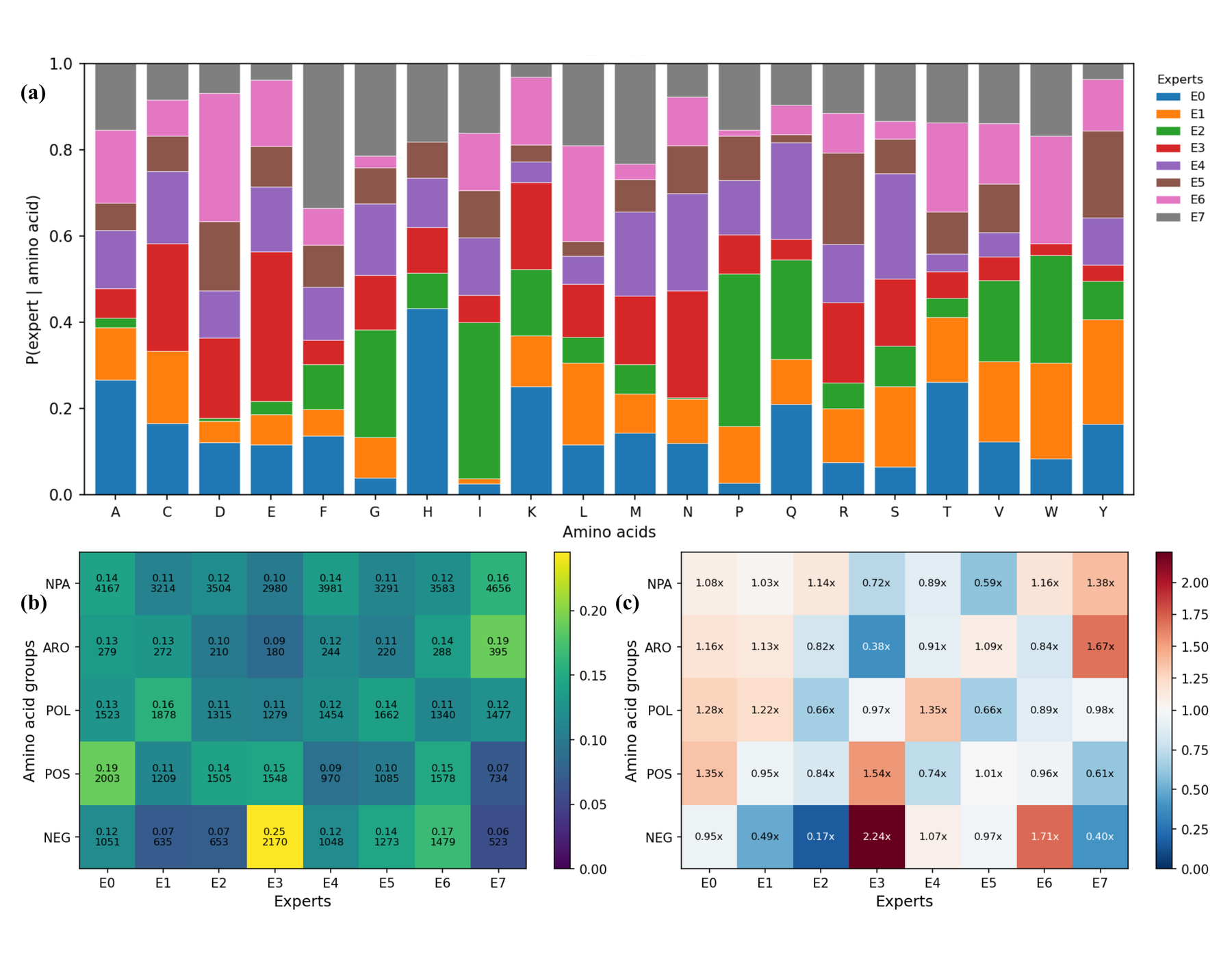
- Experts specialise by individual amino acid and biochemical group (charged, aromatic, aliphatic) with no explicit supervision.
- Transfers to short-peptide design, approaching a peptide-specialised reference (PepMLM) without any peptide-specific training.
- Evaluated on a leakage-free DB5 benchmark filtered against both the pre-training and fine-tuning corpora.
Interpretable expert specialization
Because proteins have an effective vocabulary of only twenty amino acids that fall into a few well-characterised biochemical classes, MoE-Bind offers an unusually clean window into what its experts learn. Aggregating the router's decisions over all 12 MoE layers and the 22 DB5 complexes reveals that experts organise the amino-acid alphabet along the same biochemical lines biology already recognises, with no explicit supervision toward biochemical grouping. Individual residues show sharp, consistent expert preferences (e.g. the negatively charged residues Asp and Glu both route mainly to Expert 3, and histidine to Expert 0), and these letter-level patterns aggregate cleanly into group-level specialisation.
BibTeX
@article{sarkar2026moebind,
  title   = {MoE-Bind: Guiding De Novo Protein Binder Generation with Sparse Experts},
  author  = {Sarkar, Dipayan and Sarkar, Chiranjib},
  journal = {bioRxiv},
  year    = {2026},
  pages   = {2026.06.13.732043},
  doi     = {10.64898/2026.06.13.732043},
  publisher = {Cold Spring Harbor Laboratory}
}