Deep-Interact Studio: An Interactive Deep Learning Model Building Platform for Biomolecular Interaction Prediction
1 Computational Systems Biology Laboratory, Department of Bioinformatics, University of North Bengal, India
bioRxiv 2026.07.02.736034 · Posted July 7, 2026 · CC-BY 4.0
Abstract
Motivation. Deep learning has become essential for predicting biomolecular interactions, yet most web-tools expose only a single, pre-built model with a fixed architecture that users cannot redesign, retrain on their own data, or compare. They are typically dedicated to one interaction type and often one species, and report prediction scores with little interpretability, forcing researchers across several disconnected, single-purpose tools and limiting flexibility, reproducibility, and long-term usability.
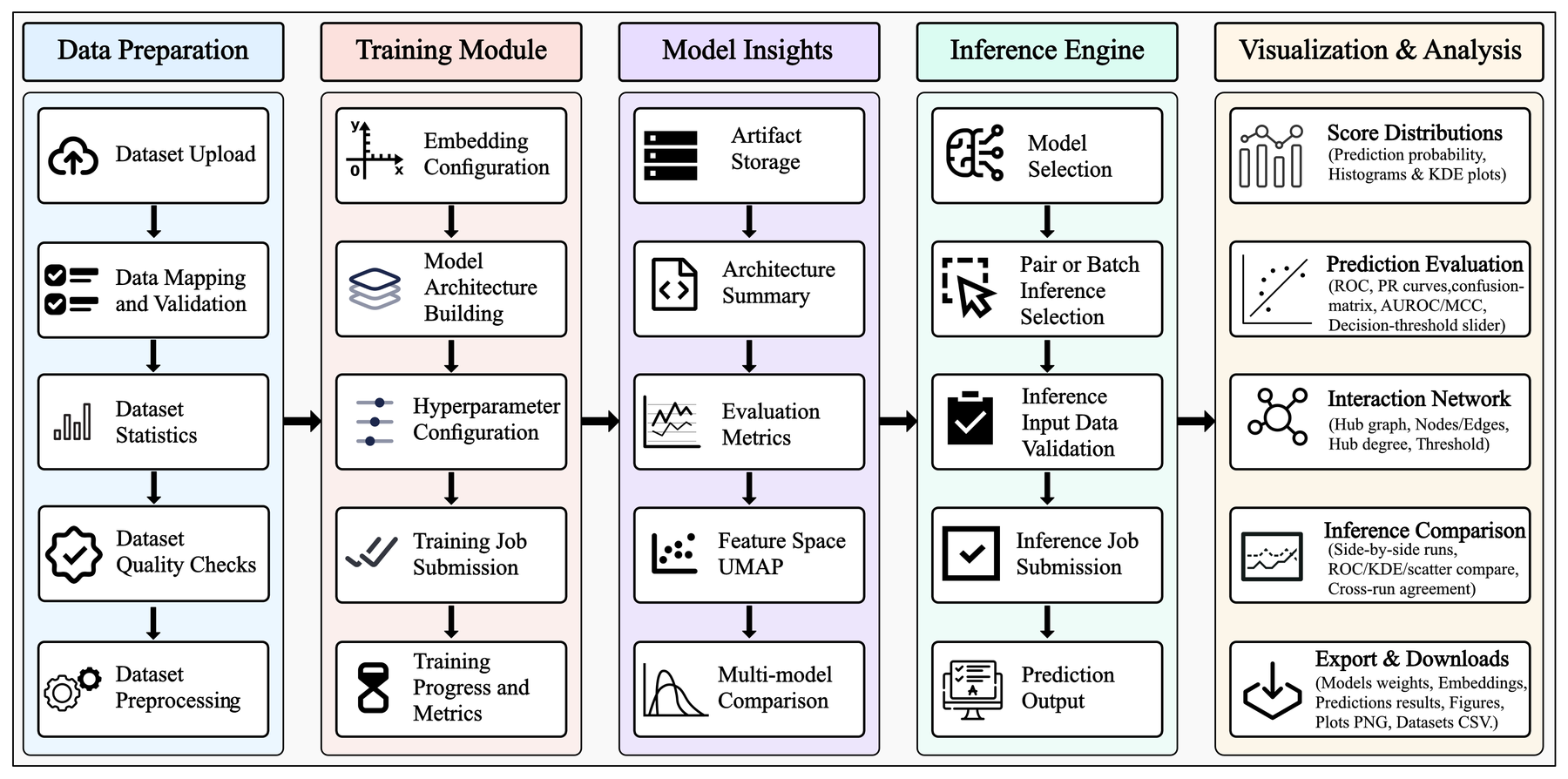
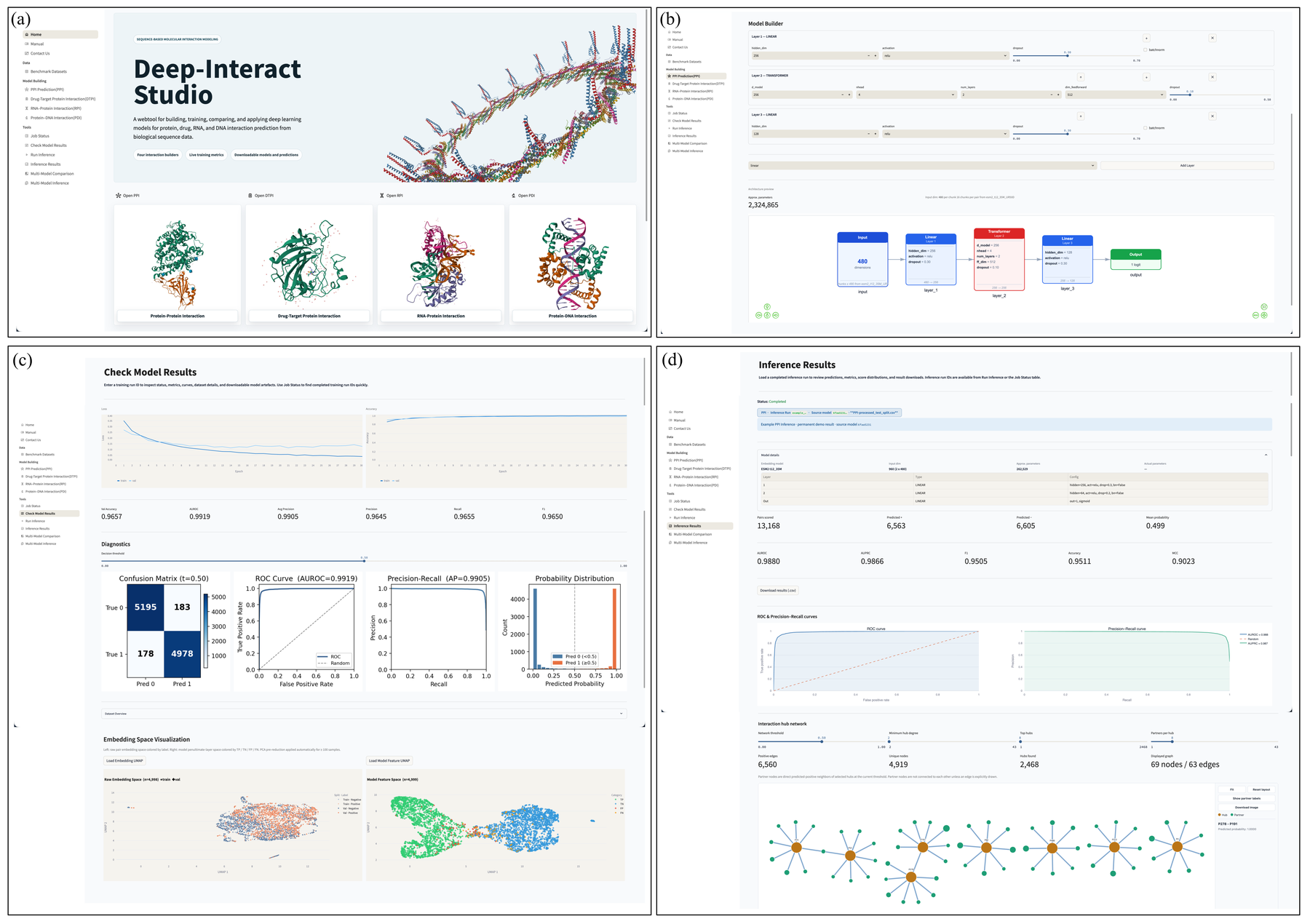
Results. We present Deep-Interact Studio, a unified, web-based deep-learning platform that shifts interaction prediction from a model-centric to a user-driven, comparative, and interpretable paradigm. Within a single interface spanning all four interaction classes (protein-protein, drug-target, RNA-protein, and protein-DNA), users design their own model architectures layer by layer, configure training hyperparameters, and train them on their own data, including custom, species-specific datasets. Multiple user-built models can then be trained under identical conditions and compared side by side at both the training and inference levels, while integrated interpretability (SHAP-based feature attribution, embedding-space visualization, and interaction hub analysis) turns predictions into auditable, mechanistically grounded results.
Availability. Deep-Interact Studio is freely available as a web application at deepinteract.compbiosysnbu.in, with no login or installation required.
PPI · DTPI · RPI · PDI
side by side
the browser
required
Highlights
- One interface, four interaction classes: protein-protein, drug-target, RNA-protein, and protein-DNA, replacing several disconnected single-purpose tools.
- Design your own architecture: a layer-by-layer builder (linear, CNN1D, BiLSTM, GRU, transformer, residual) with per-layer control of dimensionality, activation, dropout, and normalization.
- Train on your own data: including custom, species-specific datasets, on frozen ESM-2 and ChemBERTa foundation-model embeddings.
- Multi-model comparison: up to five user-built models trained under identical conditions and compared side by side at both training and inference, with per-sample disagreement scoring.
- Interpretable by design: SHAP feature attribution, UMAP embedding-space projection, and interaction-hub network views turn scores into auditable results.
- Reproducible: a central model registry stores each architecture, configuration, metrics, and embeddings; all results export in machine-readable form.
Inside the platform
Video walkthrough
BibTeX
@article{sarkar2026deepinteract,
  title   = {Deep-Interact Studio: An Interactive Deep Learning Model Building Platform for Biomolecular Interaction Prediction},
  author  = {Sarkar, Dipayan and Bardhan, Koushik and Sarkar, Chiranjib},
  journal = {bioRxiv},
  year    = {2026},
  pages   = {2026.07.02.736034},
  doi     = {10.64898/2026.07.02.736034},
  publisher = {Cold Spring Harbor Laboratory}
}